







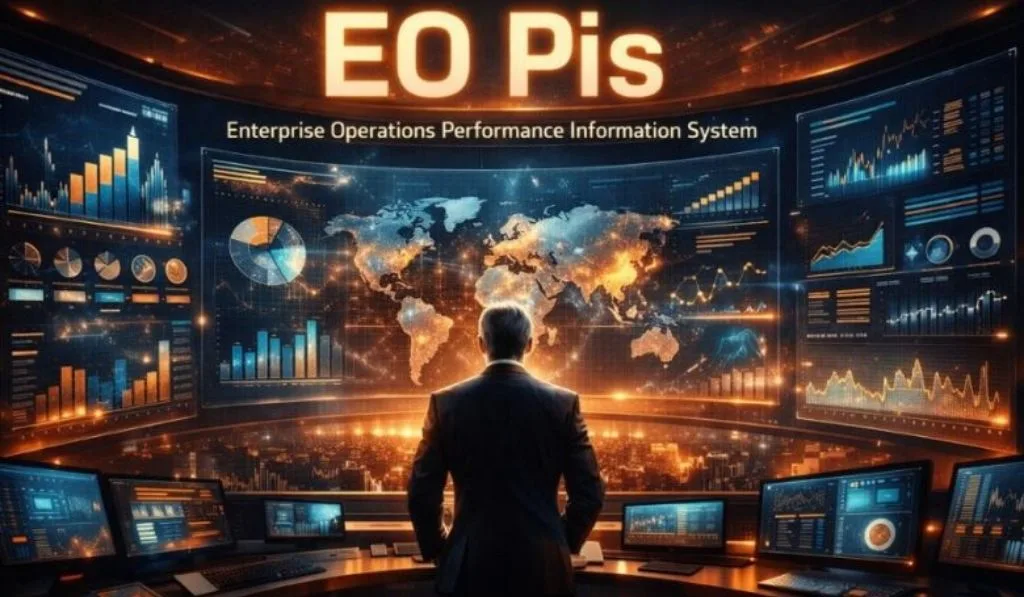
You’ve heard of EO Pis, maybe you don’t know what it is or if it’s for you or not. Enterprise Operations Performance Information System (EO Pis) is a structure that gathers information from the entire organisation and makes it visible and understandable for leadership. This article discusses what EO Pis is, how it is actually used within a business, where it is different from tools you might be familiar with, and some things to take into account prior to implementing EO Pis.
What EO Pis Means
EO Pis is short for Enterprise Operations Performance Information System. It’s a strategy, not a program, and it provides executives with a holistic view of their company’s performance throughout all departments.
Let’s look at the meaning of each of the names in action:
Enterprise Operations (EO): The day to day operations which make a business run, finance, HR, supply chain, sales, customer service.
Performance Information System (PIS): A system that is organized in order to gather, transform and display data, which are used to track and respond to performance.
EO Pis spans the divide between ground and leadership-level experiences.
One caveat: In some wellness situations “EO PIS” may mean Essential Oil Plant-Integrated Solutions. It’s another altogether different arena. In this article, you will learn about the Business and Operations definition.
How to Execute EO Pis
For most large organizations, there already is a mechanism in place for monitoring performance. The issue is, those systems don’t communicate with one another. Sales is the first to report its numbers. There are special finance models. Operations monitors itself. All of them are below EO Pis.
A simple perspective of data movement in an EO Pis framework:
| Data Source | What It Feeds Into EO Pis |
| ERP (such as SAP, Oracle) | Control of financial records, procurement and inventory |
| CRM (e.g., Salesforce) | Sales pipeline, customer activity, revenue forecast |
| HR systems (e.g. Workday) | Performance is measured by headcount, productivity and turnovers |
| Integration of IoT and operation tools | Timely production, supply chain, logistics data |
| Marketing platforms | The amount of money spent on the campaign, conversion rates, and quality of leads raised |
EO Pis aggregates all of this information into one intelligence layer. Leadership can now see one dashboard instead of five conflicting reports.
It’s not only numbers coming out. With a robust EO Pis, correlations can be displayed, such as the relationship between the delay in production and the retention rate, or the relationship between spending efficiency in marketing and sales closing.
The Differences Between EO Pis and Tools You’re Familiar With
A lot of people wonder, what is the difference between EO Pis and ERP or a BI tool such as Tableau or Microsoft Power BI? The solution lies in the difference between each one’s intended use.
| Tool | Primary Purpose |
| ERP (SAP, Oracle) | Carries out transactions and operations |
| BI tools (Tableau, Power BI) | Demonstrates visual literacy skills and provides data analysis skills |
| KPI dashboards | Reports key metrics at the department level |
| EO Pis | Relates all of the above into a strategic executive perspective |
ERP systems will deal with the work. BI tools assist you to consider it. EO Pis explains what is going on to the leaders. It’s additional, not a substitute.
Where EO Pis Is Used
The industry agnostic nature of EO Pis is one factor that continues to make the conversation, in very different industries.
Healthcare: Hospital systems leverage it to achieve a balance between patient outcomes, cost efficiency, staffing requirements, and compliance standards.
Manufacturing: Monitors manufacturing performance, equipment downtime and supplier performance to financial targets.
Retail: Integrates inventory management, store performance and ecommerce data into a single view for leadership.
Finance and Banking: Tracks risks, regulatory matters, and portfolio metrics in real time.
Technology: Enables product leaders to understand the contribution of engineering to customer growth and revenue.
The common denominator is a framework that can be used by any organization that produces multiple data streams that can be made coherent at the executive level.
What Makes a Good EO Pis Implementation
This is where many businesses get into trouble. EO Pis is not a purchaseable product. It’s an outline you build and customize based on your organization’s real strategy.
The stages of a successful implementation are as follows:
- Create a vision of success, determining what the leadership team values outcomes to be successful.
- Identify data sources, understand the systems available and what data they contain.
- Establish the correct performance indicators, select measures that align with strategy and not just what can be easily measured.
- Connect your systems, create the links between ERP, CRM, HR and other systems.
- Create the executive view, create dashboards that bring up the relevant information at the appropriate level of granularity.
- Build leadership and teams, ensure knowledge of how the built items are used.
- Regular review and refinement, the framework should develop with the business’ development.
The single biggest failure mode is measuring all the things and not associating any of the measures with a strategic decision. A great EO Pis setup is selective.
EO Pis and KPIs: Frequently Asked Questions
KPIs and EO Pis are often mentioned together, but they’re not synonymous.
KPIs are individual measurements. Customer acquisition cost. Employee turnover rate. Gross margin. There is one thing to be learned in each one.
EO Pis joins those measurements. It illustrates the impact of the customer acquisition cost on gross margin in Q2 and how that impacted a headcount decision. It develops the story of the numbers, that is what executives really need when making strategic decisions.
KPIs are like the individual instruments in an orchestra while EO Pis is like the conductor who understands all the instruments together.
Read more: Fanisco Explained: What It Really Means, Where It Comes From, and Why It Keeps Showing Up
What EO Pis Is Not
EO Pis doesn’t do a few things, and it’s good to be clear about these things, there is a lot of vague writing about this.
- It’s not a particular piece of software, but a collection of software products.
- It cannot be a substitute for ERP, CRM or any existing operational system.
- Does not “fix” anything by itself when implemented.
- It cannot be used if the underlying data is not clean and reliable.
The more wrong or incomplete information that is fed into an EO Pis framework, the more wrong or incomplete the executive view will be. Data quality is the cornerstone on which all other depends.
The Future of EO Pis
Data usage and integration in organizations is rapidly evolving. More firms are incorporating AI into their performance systems in 2026. AI’s ability to detect anomalies, identify potential risks, and even recommend resource adjustments before any human can see the pattern in EO Pis can be a game-changer.
This shifts EO Pis from reactive to predictive. Unlike the last quarter, it does not show what has occurred in the previous quarter, but what it expects to see for the next quarter based on the previous quarter’s trends. The change is significant for companies that require agility in an unstable environment.
More companies are also expected to report environmental and social performance, and EO Pis are also being included as sustainability measures. Now that you understand the concept of enterprise performance management, you can see how EO Pis fits into a larger suite of tools and practices that organizations can use to manage and enhance performance.
The future of EO Pis is clear, it’s no longer a niche tool for a handful of early adopters, but a standard part of large organizations’ self-management.
Final Thoughts
EO Pis is one of those ideas that is complicated until you see what it is solving. The majority of organizations have data. What they usually don’t have is a means of putting that information to work for the people who must make decisions. That’s where EO Pis comes in!
EO Pis is a framework that is worth understanding if you’re a leader and you want to better understand how your organization is doing, or if you are considering whether your current systems are delivering what you need or not. The acronym is not significant. It’s in the stories you are able to tell when all your data finally tells one.
Frequently Asked Questions
What is the meaning of EO Pis?
EO Pis: Enterprise Operations Performance Information System. It is a strategy that can be used to integrate data from multiple sources within an organization into a unified executive perspective, including finance, operations, HR, or sales.
Is EO Pis a software product that can be purchased?
EO Pis is NOT a product. It’s a framework and an approach that organisations adopt, by linking existing systems such as ERP, CRM and HR systems with one unified intelligence layer for leadership.
What was the difference between EO Pis and traditional KPIs?
KPIs are metrics related to individual activities. EO Pis links those metrics in different departments and highlights their relationship with each other and with the strategy. It gives context, it doesn’t just give numbers.
Does EO Pis just apply to big companies?
EO Pis is widely recognized as predominantly being used within large businesses due to the amount of data generated by these companies, but the model can be adapted to smaller businesses. A single performance view can be useful for any organization that creates data in various functions.
Which of the following comes first in implementing EO Pis?
The first step is to establish what your organization is really trying to accomplish strategically. Leadership must agree on outcomes that are important before connecting systems and creating dashboards. From this clarity everything else in an EO Pis setup flows.
Could sustainability or ESG data be incorporated into EO Pis?
Yes. More and more, organisations are adding environmental, social, and governance metrics to their EO Pis frameworks. This enables the management to view the financial and non-financial performance side by side, a common demand from investors and regulators.