








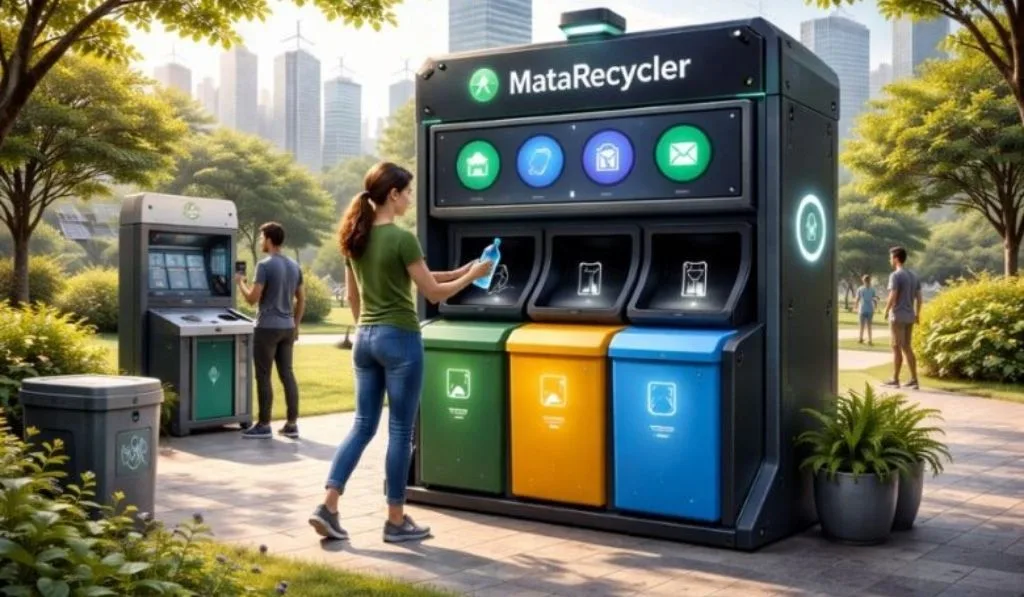
You’ve likely been in a situation before where you had to decide whether a takeout container goes in the recycling bin or in the garbage. You’re not alone. Confusing, inconsistent, and frustrating rules for recycling, most people want to recycle! Designed to eliminate that confusion, MataRecycler is an AI-powered recycling system that utilizes smart sensors, computer vision, and real-time data to ensure accurate waste sorting and monitor recycling outcomes at home, in business, and in cities.
What is MataRecycler?
MataRecycler is an intelligent recycling system which is capable of identifying and sorting recyclable materials with the least human effort by the use of artificial intelligence, automated sensors, and machine learning. It can identify plastic, paper, metal, glass, cardboard, organic, and electronic waste and automatically direct them to the appropriate processing stream.
The title is quite descriptive. The word ‘Mata’ comes from the word used for watching and targeting in several languages, and this is what the system does: it observes, identifies, and acts. There’s not a lot that’s different from a regular recycling bin, except that MataRecycler makes the decision for you, with a high degree of accuracy that humans cannot consistently achieve.
The Core Problem It Solves
Let’s first look at what MataRecycler is fixing.
Contamination is a big issue with the U.S. recycling system. Recycling loads are rejected and sent to landfill if items are not recyclable. This is sometimes referred to as wishcycling, and involves individuals throwing away products in the hopes that they will be recycled, but are not. Typical culprits are pizza boxes that are grease-covered, plastic bags, and containers that are contaminated by food.
The ramifications are profound:
- Municipalities are losing millions of dollars a year on loads that are not accepted for recycling.
- The contaminated materials cannot be recycled, and thus end up right where recycling was meant not to go.
- The labor expenses to manually separate trash from recyclables at recycling centers are higher.
- If people don’t feel their recycling efforts are making a difference, they lose faith in the program.
MataRecycler solves all these problems at the waste disposal site, before the contamination can spread.
How MataRecycler Works, Step by Step
Every time an item is thrown away it goes through the system in a clear sequence:
- Detection — The product is detected instantly the moment it passes through the system by sensors and AI cameras, which detect the material composition of the product within seconds.
- Classification — Algorithms classify the item into a recycling category, even for more complex materials such as multi-layer packaging.
- Sorting — The automated mechanisms guide the item to the appropriate collection channel without any decision required from the user.
- Data recording — The system records the transaction, including what was recycled, when, and how much.
- Reporting — That information is reported to a cloud platform that can be accessed by facility managers, city planners, or a business sustainability team to view recycling performance.
The process is real-time and it gets better as the system learns more about materials and becomes more capable of pattern recognition.
What Makes MataRecycler Unique
| Feature | Traditional Recycling | MataRecycler |
| Sorting method | Manual, user-dependent | Automated, AI-driven |
| Contamination rate | High (user error) | Significantly reduced |
| Bin monitoring | None | Real-time fill-level sensors |
| Data reporting | Minimal | Detailed analytics dashboard |
| User guidance | Not present at point of disposal | App-based sorting reminders |
| Material types handled | In accordance with local rules | Plastic, paper, metal, glass, e-waste, organics |
The Mobile App Component
A part of MataRecycler that most of the competitors miss is the user-friendly application. The app represents a direct link between the citizens and the recycling network. It reminds users when it is time to recycle, gives sorting guidance on certain items, and displays users’ recycling performance against targets or community averages.
This feedback loop is important and should not be overlooked. Numerous studies in behavioral environmental science have proven that individuals are more likely to recycle when they are given positive reinforcement and direct instructions. The app transforms recycling from an educated guess to a step-by-step process.
Benefits for Businesses and Organizations
MataRecycler addresses two issues for businesses: environmental compliance, and cost management.
ESG (Environmental, Social, and Governance) reporting is a challenge for many businesses in the U.S. market. Investors, regulators, and customers are increasingly looking at companies to show responsible waste practices with real data. MataRecycler does that automatically, and makes sustainability reporting much less time consuming.
On the cost side:
- Less contamination means fewer loads rejected and lower disposal fees.
- Fuel and labour costs are reduced by optimum collection schedules, as determined by real-time bin sensor data.
- Increased recycling rates will reduce the amount of general waste that has to be disposed of, which is usually more expensive.
MataRecycler infrastructure can be deployed in offices, retail, warehouses, and manufacturing facilities.
MataRecycler as a Smart City Solution
In America, cities are coming under increasing pressure to provide better waste management services at no increased expense. MataRecycler can seamlessly integrate into smart city infrastructure as it produces the data that urban planners are looking for.
One practical example is collection route optimization. Smart bins can transmit their fill status instantly, eliminating the need for collection trucks to adhere to set collection schedules, which leads to the collection of half-empty bins and the overflow of others. Routes can be dynamically adjusted to reduce fuel consumption and vehicle emissions.
Another is performance tracking. City managers can identify which parts of the city have the most contamination and allocate resources, whether that’s education or community programs, to those areas instead of engaging in mass campaigns that are reaching residents who are already recycling properly.
This targeted, data-driven approach is the way cities make measurable progress toward becoming zero waste, not just setting aspirational targets without a system to execute them.
The Environmental Argument
Each product that is successfully recycled and returned to the manufacturer is one that does not require new raw materials from the land. Recycled aluminium from cans can save up to 95% of the energy needed to make new aluminium from raw bauxite ore. Paper recycling saves timber by reducing the demand for it. Recycling plastic reduces the need for petroleum raw materials.
MataRecycler gets the most materials through that loop. It minimizes contamination and increases sorting accuracy, leading to more usable material on the other end of the system. This is the essence of the circular economy, a circular system characterized by the use of materials for as long as possible, with waste entirely designed out.
It is very different from linear waste management. A linear model takes in resources, consumes them, and then discards them. A circular model ensures those resources are kept in play. MataRecycler is one of the most useful tools currently out there to help move communities and businesses from the first model to the second.
Read more: Bropu Meaning: What This Rare Word Actually Means and Where It Shows Up
The Highs and the Lows
MataRecycler is no easy pill to swallow and it’s good to be honest about it.
The initial investment required for the deployment of sensor networks, AI infrastructure, and sorting hardware is a reality. This technology may be more difficult to obtain in lower income areas or smaller municipalities that do not have the public funding or grant support. There is also the issue of connectivity, as consistent internet or network connectivity is needed to enable real-time data transfer and rural areas could have certain constraints.
There is a lack of public awareness as well. Without a widespread understanding of how to use it, or a lack of confidence that recycling is effective, even the most effective sorting system is of little value. Any rollout of MataRecycler must be completed with community education programs to encourage meaningful participation.
These are problems that can be solved, however. The technology is good.
Final Thoughts
MataRecycler is interesting because it addresses recycling from a perspective that most programs don’t think about, which is the point of disposal, where most failure occurs in recycling. Rather than relying on the individual throwing away something to make a correct decision, it relies on technology so that the right decision becomes automatic.
If you’re responsible for waste management at a company, or involved with municipal planning, or just recycling without worrying about every container, MataRecycler is a worthwhile change of what recycling can really be. The technology exists. The ecological argument is solid. The question remains how fast communities and organizations will move towards its adoption.
Frequently Asked Questions
What is MataRecycler?
MataRecycler is an AI recycling system that leverages smart sensors, computer vision, and machine learning to automatically detect and categorize waste. It is designed for homes, businesses, and city infrastructure to enhance recycling accuracy and minimise contamination.
How does MataRecycler minimize contaminants in recycling?
It takes the human element out of the sorting process. The system can be used to ensure that only recyclable loads are used and the material is known in the system, rather than relying on the user to know that a particular type of plastic is recyclable locally.
Is MataRecycler available to be used at home by individuals?
Yes. The mobile application part of MataRecycler offers sorting advice, reminders for pick-ups, and performance indicators for recycling. The app supports better and more accurate recycling even with partial hardware rollout.
Can MataRecycler be adopted at a city-scale?
It is designed to scale up from single buildings to entire urban districts of a city. The system’s real-time bin monitoring and analytics dashboard provide city planners with the data they need to optimize collection routes and determine problem areas.
What contribution can MataRecycler make to businesses for sustainability reporting?
Detailed information is automatically created on materials recycled, quantity recycled, and consistency of recycling materials. The information can be directly incorporated into ESG reports and environmental compliance paperwork, thereby saving teams a considerable amount of time.
What can you put in MataRecycler?
It can collect plastic, paper, metal, glass, cardboard, organic wastes, and e-waste. Its machine learning algorithms are able to identify multi-layer and mixed materials, which are often hard for manual sorting.