





If you’ve heard Nova Scola and wondered, you aren’t alone. The word Nova Scola is Latin and means literally “new school,” and it was one of the more popular education concepts to be searched online in 2026. This article explains what it is, where it originated, how it functions in actual classrooms, and what parents and students should be aware of before interacting with any school or programme with this name.
Quick Overview of Nova Scola
| Detail | Information |
| Origin of term | New school, or new place of learning |
| Type | Philosophy and concept of education, also used as a school/brand name |
| Core focus | Student Centred Learning, Holistic Learning and Future Skills |
| Key influences | Maria Montessori, John Dewey, and Paulo Freire |
| Associated models | Project Based Learning, Personalized Learning, Design Thinking |
| Countries that use it | USA, Brazil, Portugal, and India, influenced by Finland |
| Primary audience | Students K-12, Parents, Educators, School Administrators |
What Nova Scola Really Means
Online, there are two different uses for the term, and when they are confused, there is a lot of frustration.
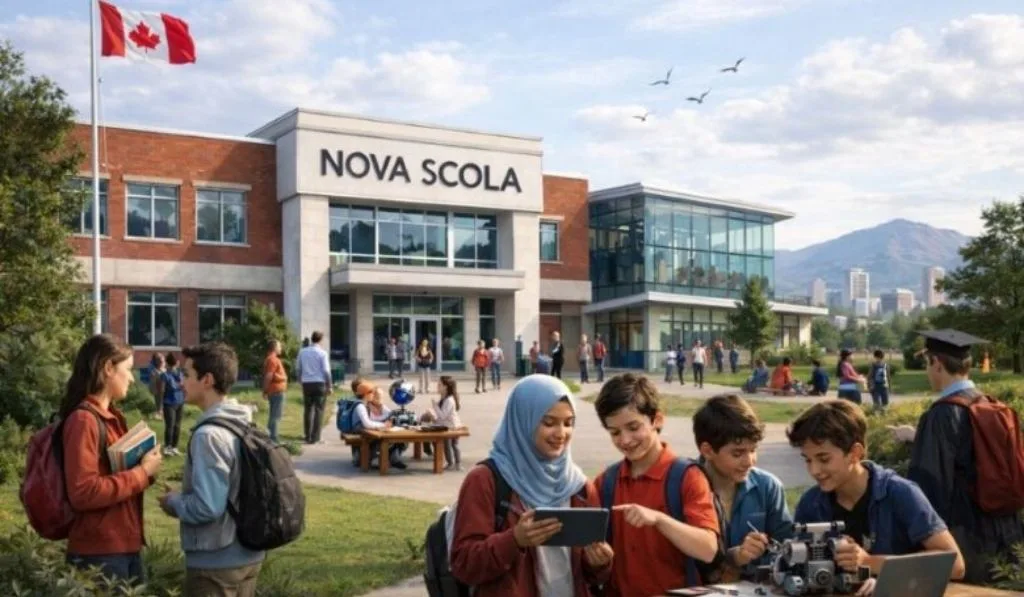
First, it works as a general concept. The Nova Scola approach describes a set of contemporary educational values: student-centred, real world project learning, student growth through portfolios, and above all, caring for student emotions as well as skills.
Second, it is used as a trade name or school name. There are several institutions and education consulting services in the world that have taken “Nova Scola” as their name. They are independent with their own programs and application procedures.
Knowing the meaning in a particular context is important. You might get a different search result when you look up “Nova Scola” as a concept, versus “Nova Scola” as a school in your city.
The History and Origins of the Concept
Nova Scola’s philosophy wasn’t just an out of nowhere thing. It is influenced by the teaching ideas of three thinkers who have shaped education in the last century.
Maria Montessori (1870,1952): Believed that children learn best through exploration and investigation of their environment, not through listening.
John Dewey (1859,1952): Believed that experiential, hands-on learning is essential and that education should relate to real life.
Paulo Freire (1921,1997): Advocated for dialogue over the “banking model” of education, which involved transferring knowledge to passive learners, and called for empowerment.
Today, Nova Scola is based on all three. It takes Montessori’s emphasis on the individual learner, Dewey’s focus on doing more than memorizing, and Freire’s idea that education should engage a person’s whole humanity, and packages them up for the digital age.
How Nova Scola Actually Works
To grasp Nova Scola, it helps to compare it with what most people would have encountered in school.
| Feature | Traditional Schooling | Nova Scola Model |
| Learning pace | Same for entire class | Adjusted to suit each student |
| Assessment | Standardized tests | Portfolios, projects, presentations |
| Teacher’s role | Teacher at the front of the class | Mentor alongside the student |
| Curriculum | Fixed textbook chapters | Real-world problems and student interest based |
| Success measure | Grade point average | Skill development, self-assurance, problem solving |
| Technology | Supplementary, occasional | Integrated as a core learning tool |
A classroom at a Nova Scola school might spend a day doing the following: researching local water quality, sampling and gathering data, presenting the results to a city official, and writing a journal entry about what they learned. In one project they teach science, writing, civic awareness and communication.
The Four Core Philosophies
There is no one official organization that defines Nova Scola, but the theme that runs through it always centres on four things.
Personalized learning pathways. A journey for each child that is designed around their strengths, speed and interests. Through frequent check-ins, and more and more through adaptive digital tools, teachers fine-tune what each pupil is doing.
Project-based learning. Students engage in problems that are real or realistic and are solved over days or weeks. They seek out information, work as a team, create a product and share it. Learning of the subject matter occurs during the process, rather than beforehand.
Emotional intelligence and academics. Self-awareness, empathy, conflict resolution and resilience are explicitly taught in schools that use this model. They are not soft add-ons, but integral parts of the programme.
Community and real world relationships. Learning goes beyond the classroom wall. Students engage with local businesses, nonprofits and community issues. This helps make what they learn relevant and meaningful.
Does It Really Work? What the Data Shows
This is the most important question that most parents would ask first. The evidence is improving, but still developing.
One school in Brazil had an internal tracking system that showed a 40% increase in student engagement after one semester of implementing Nova Scola frameworks formally. One California charter school that uses VR in its science curriculum reported fewer classroom behavior problems, and teachers reported that nearly all students remained engaged during lessons.
The Nova Scola model is based on project-based learning, and research has proven that such instruction has a lasting effect on students’ memory of content and their problem-solving skills, while these are weaker with traditional instruction. A school in rural India that used story circles and projects relevant to the local context instead of textbooks achieved an improvement of 25% in test scores, particularly in girls’ school attendance.
These are not pan-European studies. They are providing some early evidence that schools that have taken the model seriously, with the aid of trained teachers and community involvement, are showing signs of success.
Read more: Serlig Explained: What It Really Means, How It’s Used, and Why People Keep Searching It
Questions Parents Should Ask Before Enrolling
If your child goes to a school with a Nova Scola name or values, here are some questions to ask the school administration:
- Where and how do teachers get trained in this, and how frequently?
- What is the process for tracking student progress and informing parents?
- Do projects explicitly include core skills such as math or reading, or are they expected to emerge through the project?
- How might it look when students move from this model to high school or university?
- What methods are used to seek student and family feedback, and how does the school respond?
The quality is never guaranteed by a label, Nova Scola included. The quality is the result of trained and supported teachers and time for them to collaborate. The concept gives a school a direction, but it is the people who determine whether or not the school will reach it.
Final Thoughts
The more you read about Nova Scola, the clearer it becomes. It was initially a Latin term, then a shorthand for a set of education ideas that have been debated since the early 1900s, and is now a name that schools, platforms, and consultants in a number of countries are using to indicate a different understanding of education than the one traditionally used.
The name is not the important part in 2026. It’s the questions the name poses: Am I teaching my child to think, or to remember? Is the school committed to its mission, or is it an afterthought? Are they acquiring the skills they need to put to use? Whether it’s Nova Scola or anything else, those questions must be answered honestly.
FAQ
What is Nova Scola?
The word “nova” is Latin for “new” and “scola” means “school.” It is now the term used for what is known as personalized learning, projects, emotional learning, and training for life rather than for standardized exams.
Is Nova Scola a school or just an idea?
It’s both, depending on context. As an idea, it is a set of contemporary education principles. The name has also been used by various schools, platforms and education consulting groups worldwide as their official name. When you see the word online, always ask which one is being referred to.
How is Nova Scola different from a traditional school?
The largest differences are in pacing, evaluation, and the teacher’s role. Traditional schools typically teach and assess at a single pace for everyone, with a focus on tests. Nova Scola is flexible to every learner, uses projects and portfolios to evaluate, and places the teacher as mentor instead of lecturer.
Is there research to support the Nova Scola approach?
The actual term is recent, but the concepts that form its foundation, like project-based learning and student-centered teaching, have been researched over many years. Several programs have shown better engagement, attendance and retention of skills. Brazil and California both have promising early school-level data.
Who is Nova Scola aimed at?
The principles are valid for all age levels, from elementary to high school. The majority of schools and programs that use this approach develop age-appropriate versions of similar foundations, involving younger children in play and hands-on activities and older children in more complex, community-based work.
Can these concepts work in a public school, or only a private school?
They can work in any school context, though implementation can differ. Nova Scola principles have been adopted in several public and charter schools in the USA, Brazil, and India in small, incremental, and cost-effective ways, including beginning at a small scale, shared devices, and peer learning among teachers. Support helps, but it is not the only factor.