








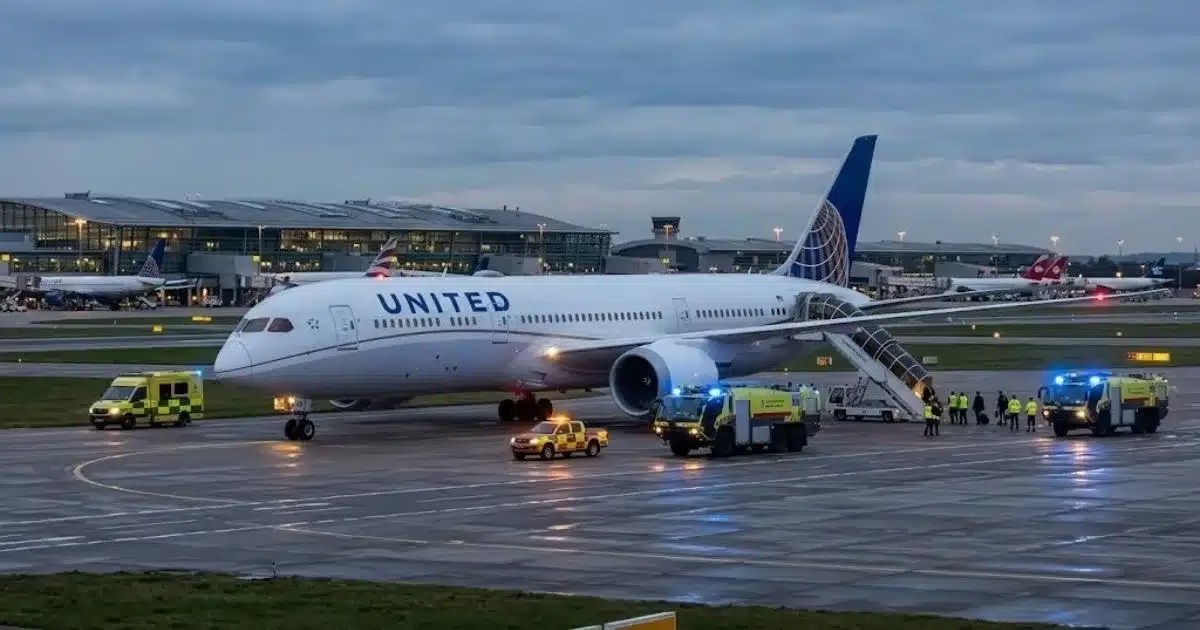
When a flight declares an emergency mid-air, everything that follows happens fast. Passengers grip their armrests. Flight attendants move calmly through the cabin. Pilots coordinate with air traffic control across multiple frequencies. And somewhere on the ground, an airport prepares to receive an aircraft that was never supposed to land there.
The United Airlines flight UA770 emergency diversion is one of the most searched aviation incidents of 2025, and for good reason. It combined a high-profile transatlantic route, a technically significant aircraft, a credible in-flight system alert, and a textbook emergency response that ended with every single passenger and crew member walking away unharmed.
This guide covers the full story: the route, the aircraft, the moment the emergency began, the decision to divert, the landing, the passenger experience, and what the entire incident reveals about how aviation safety actually works.
What Is United Airlines Flight UA770?
United Airlines flight UA770 is a scheduled transatlantic service operated by United Airlines between Barcelona El Prat Airport (BCN) in Spain and Chicago O’Hare International Airport (ORD) in Illinois, USA. It is a long-haul intercontinental route operated on a regular schedule, covering approximately 7,000 kilometres across the North Atlantic.
The route is operated using wide-body, long-range aircraft capable of sustaining extended overwater flight. In 2025, the specific aircraft operating the UA770 emergency diversion was a Boeing 787 Dreamliner, one of the most advanced commercial aircraft in service anywhere in the world. Multiple sources identify the registration of the aircraft involved in the primary May 2025 diversion as N26902, a Boeing 787-8 or 787-9 variant.
The flight number UA770 has become unusually prominent in aviation news coverage because the same flight number has been associated with more than one emergency diversion event across 2025. Different incidents, involving different aircraft, different routes, and different technical circumstances, have all carried the UA770 designation at different times during the year. This has created some confusion in media coverage, which this guide addresses in a dedicated section below.
The Primary Incident: 27 May 2025, Barcelona to Chicago
The most extensively documented and widely reported United Airlines flight UA770 emergency diversion occurred on 27 May 2025. The flight departed Barcelona El Prat Airport on a standard scheduled service bound for Chicago O’Hare. Onboard were passengers and crew making what should have been a routine transatlantic crossing of approximately nine to ten hours.
Approximately 90 minutes after takeoff, while the aircraft was cruising at approximately 37,000 feet over European airspace, the flight crew detected irregular readings in the aircraft’s cabin pressurization system. The pressurization system is one of the most critical comfort and safety systems on any high-altitude commercial aircraft.
It maintains air pressure inside the cabin at a level equivalent to approximately 6,000 to 8,000 feet of altitude, preventing the physiological effects of the extremely thin air at cruising altitude, where outside atmospheric pressure would be fatal to unprotected humans within minutes.
The readings indicated irregular behavior within the system. Crucially, the situation did not escalate to an actual loss of cabin pressure. Oxygen masks did not deploy. Passengers were not placed in immediate physical danger. However, the pilots correctly identified the alert as requiring immediate action. In aviation, a pressurization system anomaly that goes unaddressed can escalate rapidly and unpredictably. The crew made the decision to treat the alert as a genuine emergency.
Read also: Bilieter Explained: Meaning, Role, and How Digital Ticketing Systems Are Changing Access Management
Squawk 7700: The Emergency Declaration
Within minutes of detecting the pressurization alert, the flight crew activated Squawk 7700 on the aircraft’s transponder. Squawk 7700 is the internationally standardized aviation emergency code that broadcasts a continuous emergency signal to all air traffic control facilities and aircraft tracking systems within range.
When a transponder squawks 7700, the effects are immediate and coordinated. Air traffic control facilities across the region are alerted simultaneously. The aircraft is given priority routing, meaning all other traffic is moved to give the emergency flight clear airspace and direct routing to the nearest suitable airport. Emergency response teams at the diversion airport are activated and prepared. Ground vehicles, including fire engines, ambulances, and airport emergency services, are deployed to the runway in preparation for the landing.
The United Airlines flight UA770 emergency diversion squawk was detected and reported by aviation tracking services in real time, which is why the incident generated rapid media coverage even while the aircraft was still airborne. The Squawk Alert aviation monitoring account on X (formerly Twitter) posted the alert directly: the aircraft, a Boeing 787-8 Dreamliner with registration N26902, had declared an emergency and was diverting to London.
The Diversion to London Heathrow Airport
The crew selected London Heathrow Airport (LHR) as the diversion destination. Heathrow was the optimal choice for several compounding reasons.
Geographically, it was among the closest major airports to the aircraft’s position when the emergency was declared. An aircraft that had departed Barcelona approximately 90 minutes earlier and was climbing through European airspace would be positioned over or approaching the western approaches of the British Isles when the alert was detected. London Heathrow, located west of central London, was accessible without requiring the aircraft to fly a significantly extended distance in its compromised state.
Operationally, Heathrow is one of the best-equipped airports in the world for handling emergency diversions involving wide-body long-haul aircraft. Its runway infrastructure, emergency response capability, maintenance facilities, and ground handling capacity are among the most comprehensive at any airport in Europe. United Airlines also maintains operational infrastructure at Heathrow as part of its transatlantic network, which simplified passenger handling, rebooking, and ground coordination.
The aircraft landed at London Heathrow without incident. All passengers and crew were disembarked safely. No injuries were reported. The diversion, from the activation of Squawk 7700 to the safe landing at Heathrow, proceeded exactly as aviation emergency protocols are designed to ensure it would.
The Aircraft: Boeing 787 Dreamliner
The aircraft at the center of the United Airlines flight UA770 emergency diversion was a Boeing 787 Dreamliner, one of the most technologically sophisticated commercial aircraft currently in service worldwide. Understanding the aircraft helps explain both how the pressurization alert was detected so early and why the emergency was managed so effectively.
The Boeing 787 is built extensively from carbon fiber composite materials rather than the aluminum alloys used in older aircraft designs. This gives it a significantly lower structural weight, which reduces fuel consumption and extends operational range. More relevant to the UA770 incident, the 787’s composite fuselage allows it to maintain higher cabin humidity and air pressure than older aluminum-fuselage aircraft, improving passenger comfort on long-haul flights.
The 787 is equipped with highly sophisticated digital monitoring systems that continuously track the performance of every critical aircraft system, including pressurization, in real time. These systems generate alerts at the first sign of anomalous behavior, long before a situation reaches a point of danger. This is precisely why the crew was able to identify the pressurization irregularity and initiate the diversion while still at cruising altitude with ample time to reach Heathrow safely.
Following the landing, United Airlines grounded the affected aircraft, registration N26902, for thorough technical inspection before returning it to service. This is standard procedure following any emergency diversion involving a critical system alert, regardless of whether the system fault was confirmed during the flight or only identified during post-landing inspection.
Multiple UA770 Incidents in 2025: Clarifying the Full Picture
One of the most important clarifications for anyone researching the United Airlines flight UA770 emergency diversion is that the flight number UA770 was associated with more than one diversion event during 2025. This has created significant confusion in media coverage, with different sources describing different incidents, different routes, and different technical causes while using the same flight number designation.
The confusion arises from a basic feature of how airline flight numbers work. A flight number like UA770 does not identify a specific aircraft or a specific single journey. It identifies a scheduled service route and departure time that repeats on every operating day. The same flight number is operated by different physical aircraft on different days, and different instances of that flight number can experience completely different issues across the calendar.
In 2025, at least three distinct emergency diversions were associated with the UA770 flight number at different times of the year.
The May 2025 Barcelona to London Heathrow diversion was the most extensively reported. This involved the pressurization system alert described in detail above, with the Boeing 787 registration N26902, and resulted in a safe landing at Heathrow.
A July 2025 San Francisco to Chicago diversion also carried the UA770 designation. This incident involved a hydraulic system warning detected while the aircraft was over the Rocky Mountain region of the United States. The pilots declared an emergency and diverted the flight to Denver International Airport. The hydraulic system controls flight surfaces, landing gear, and braking systems, making a hydraulic warning one of the most serious alerts any flight crew can receive. The landing in Denver was smooth, and all passengers deplaned safely.
A further diversion in late 2025, also connected to the UA770 flight number in some media reports, involved a routing from Chicago to another location. Specific technical details of this third event are less consistently documented across sources.
All three events share the same outcome: safe landings, no injuries, professional crew responses, and the same flight number creating the appearance of a single ongoing saga when the reality is three separate, independently resolved incidents.
Why Emergency Diversions Happen: The Aviation Safety Framework
The United Airlines flight UA770 emergency diversion belongs to a broader context of how commercial aviation manages risk. Understanding why diversions happen and how decisions are made helps explain why this incident, despite generating significant media attention, is fundamentally a story of aviation safety working correctly.
Emergency diversions in commercial aviation occur across several categories of cause. Mechanical and system alerts include warnings from pressurization, hydraulic, engine, electrical, or fuel systems. Not all alerts indicate confirmed failures. Many represent early warnings of potential issues that have not yet caused actual system degradation. Aviation safety protocols treat early warnings as requiring the same response as confirmed failures because the cost of treating a false positive is a diversion, while the cost of ignoring a genuine warning could be catastrophic.
Medical emergencies involving passengers or crew represent a second major category. When a passenger experiences a serious medical event at cruising altitude, the aircraft may divert to the nearest airport where appropriate medical care is available. Cardiac events, severe allergic reactions, and other acute medical situations all trigger consideration of diversion.
Weather-related diversions occur when destination airports become inaccessible due to severe weather, when routing conditions deteriorate beyond acceptable operational limits, or when fuel consumption has been higher than planned due to headwinds and reserves cannot guarantee safe arrival at the original destination.
Security events, including credible threats or disruptive passenger behavior requiring law enforcement intervention at the nearest available airport, represent a fourth diversion category.
In the case of the UA770 pressurization alert, the cause was the first category: a system alert requiring precautionary evaluation. The decision framework for this type of diversion follows a structured process. Pilots assess the nature of the alert, consult the aircraft’s Quick Reference Handbook for applicable procedures, evaluate fuel state and airport options, coordinate with the airline’s operations center, and communicate with air traffic control to identify and clear a route to the chosen diversion airport.
The Role of Air Traffic Control
The United Airlines flight UA770 emergency diversion demonstrates the critical coordination role played by air traffic control during aviation emergencies. When Squawk 7700 was activated, ATC facilities across European airspace received the emergency signal simultaneously.
Controllers cleared airspace around the aircraft, providing direct routing to Heathrow without the delays of standard traffic sequencing. Other aircraft were vectored away from the emergency flight’s path. Heathrow’s tower was notified, and emergency services were activated on the ground before the aircraft began its descent.
This coordination happens within minutes of the emergency declaration and involves controllers across multiple national airspace authorities. Eurocontrol, the pan-European air traffic management organisation, coordinates airspace across 41 European states and its systems are specifically designed to handle emergency priority routing across national boundaries without delay.
The seamless coordination between the UA770 crew, European ATC, and Heathrow ground services is one of the reasons the incident was resolved so effectively. Every element of the response worked as designed.
Passenger Experience During the Diversion
For the passengers aboard the United Airlines flight UA770 emergency diversion, the experience combined genuine anxiety with the gradual reassurance of professional crew management.
The cabin crew’s response to the emergency declaration follows a strict protocol. Passengers are informed that the aircraft is diverting due to a technical issue. The language used is deliberately calm and precise, avoiding alarming phrasing while providing sufficient information for passengers to understand that the situation is being managed. Seat belt signs are activated and passengers are asked to return to their seats for the descent.
The absence of oxygen mask deployment was significant in terms of passenger experience. When masks deploy, the psychological impact on passengers is immediate and severe. In the UA770 case, because the pressurization issue had not escalated to actual cabin pressure loss, passengers experienced a diversion announcement and a controlled descent rather than the more alarming experience of a full decompression event.
Following the landing at Heathrow, United Airlines provided affected passengers with practical assistance. Meal vouchers were issued. Passengers were rebooked on alternative flights to Chicago. Ground staff coordinated accommodation for those whose rebooking required an overnight stay in London. The airline’s response reflected the operational readiness that large carriers maintain for exactly this type of unplanned diversion at major international airports.
Passenger Rights and Compensation
A practical dimension of the United Airlines flight UA770 emergency diversion that directly affected the passengers involved is the question of their rights and potential compensation for the disruption caused.
In Europe, flights departing from European Union member state airports are subject to EU Regulation 261/2004, which establishes passenger rights in cases of significant delays and disruptions. Since UA770 departed Barcelona, which is within the EU, European passenger rights legislation applied to the affected passengers.
Under EU 261/2004, passengers on flights diverted due to extraordinary circumstances, a category that can include genuine technical emergencies, may have limited entitlement to financial compensation for the diversion itself. However, the airline remains obligated to provide care and assistance, including meals, refreshments, and accommodation where necessary, regardless of whether the diversion falls under extraordinary circumstances.
Passengers whose onward journeys were delayed by three or more hours as a result of the diversion may have additional compensation entitlements depending on the specific circumstances and the airline’s determination of fault. Passengers who experienced this diversion and have not pursued their rights should retain all receipts, boarding passes, and documentation of the disruption.
United Airlines’ Safety Record and Fleet Management
The United Airlines flight UA770 emergency diversion occurred within the context of a major global carrier’s broader commitment to safety management and fleet maintenance. United Airlines operates one of the largest fleets of commercial aircraft in the world, including a significant number of Boeing 787 Dreamliners on its long-haul transatlantic and transpacific routes.
United Airlines maintains a comprehensive safety management system that includes regular scheduled maintenance, unscheduled maintenance in response to system alerts, and continuous monitoring of aircraft performance data through real-time telemetry. The decision to ground the N26902 aircraft for thorough inspection following the diversion reflects this safety management approach.
The Boeing 787’s pressurization system, which generated the alert on UA770, is a mature and well-understood technology. Pressurization systems on modern commercial aircraft are designed with multiple redundant components precisely to prevent single-point failures.
An alert from one component does not indicate that the entire system has failed. It indicates that one element of the system has reported behavior outside its normal operating parameters, triggering the precautionary response that the crew correctly executed.
Comparison: UA770 Incidents Across 2025
| Incident | Date | Route | Technical Issue | Diversion Airport | Outcome |
| Primary diversion | 27 May 2025 | Barcelona to Chicago | Cabin pressurization alert | London Heathrow (LHR) | Safe landing, no injuries |
| Second diversion | 28 July 2025 | San Francisco to Chicago | Hydraulic system warning | Denver International (DEN) | Safe landing, no injuries |
| Third incident | Late 2025 | Chicago area route | Not fully documented | Not confirmed | Safe outcome reported |
This table clarifies the three separate UA770 events that contributed to the flight number’s unusual prominence in 2025 aviation media coverage. All three incidents resulted in safe outcomes, confirming that the emergency response protocols functioned correctly across each event.
What the UA770 Diversion Tells Us About Aviation Safety
The broader significance of the United Airlines flight UA770 emergency diversion lies in what it demonstrates about the design philosophy of modern commercial aviation safety. Several principles are visible in this single incident.
Early warning systems work. The pressurization alert was detected by the aircraft’s monitoring systems and communicated to the crew before the situation developed into an actual system failure. This early detection window is what made a controlled, professional diversion possible.
Pilot training works. The crew’s decision to declare an emergency and divert upon receiving the pressurization alert, rather than continuing to the original destination and hoping the alert would resolve, reflects exactly the conservative decision-making culture that aviation safety depends on. Pilots are trained to treat alerts seriously and to prioritize safety over schedule.
International coordination works. The seamless transition of the emergency aircraft through European airspace, the activation of Heathrow’s emergency response, and the smooth passenger handling that followed all demonstrate the effectiveness of the international aviation safety infrastructure that operates continuously and largely invisibly beneath every commercial flight.
Redundancy works. The Boeing 787’s multiple backup systems meant that a single component alert did not escalate into an uncontrollable emergency. The aircraft’s structural and mechanical integrity was maintained throughout the diversion, approach, and landing.
Aviation remains statistically the safest form of long-distance travel in human history. The United Airlines flight UA770 emergency diversion is, paradoxically, one of the clearest demonstrations of why that is true.
Conclusion
The United Airlines flight UA770 emergency diversion of 27 May 2025 was a genuine aviation emergency that was handled with complete professionalism by the flight crew, air traffic control, airport emergency services, and United Airlines ground operations. A pressurization system alert at 37,000 feet triggered a coordinated response that resulted in a safe diversion to London Heathrow Airport, with every passenger and crew member disembarked without injury.
The same flight number’s association with two further emergency diversions later in 2025, one involving a hydraulic warning on a San Francisco to Chicago service and one less fully documented, created a pattern of media attention unusual for a single flight designation. Each incident was resolved safely. Each demonstrated the same underlying truth: aviation emergency systems, when activated, work as designed.
For passengers who travel on any transatlantic or long-haul route, the UA770 story offers genuine reassurance rather than alarm. The experience of an emergency diversion is disruptive and unsettling. The reality behind that experience is a safety system operating exactly as it should, making conservative decisions, prioritising human life over operational convenience, and delivering outcomes that the data consistently confirms as the norm in commercial aviation: everyone lands safely.
Frequently Asked Questions
What was the United Airlines flight UA770 emergency diversion?
The United Airlines flight UA770 emergency diversion refers primarily to an incident on 27 May 2025, when a United Airlines Boeing 787 Dreamliner operating from Barcelona to Chicago declared an emergency due to a cabin pressurization system alert and diverted to London Heathrow Airport. All passengers and crew landed safely with no injuries reported.
What caused the UA770 emergency diversion to London Heathrow?
The crew detected irregular readings from the aircraft’s cabin pressurization system approximately 90 minutes after departure from Barcelona, while cruising at 37,000 feet. Although cabin pressure was not lost and oxygen masks were not required, the crew declared an emergency and diverted as a precautionary measure in accordance with standard aviation safety protocols.
Were there multiple UA770 emergency diversions in 2025?
Yes. The UA770 flight number was associated with at least three separate emergency diversion events across 2025. The most documented involved a pressurization alert and diversion to London Heathrow in May 2025. A second involved a hydraulic system warning and diversion to Denver in July 2025. A third event was reported later in the year. All resulted in safe landings.
What is Squawk 7700 and why was it used during the UA770 diversion?
Squawk 7700 is the internationally standardized aviation emergency transponder code. When activated, it broadcasts a continuous emergency signal to all air traffic control facilities in range, triggering priority routing, cleared airspace, and ground emergency response activation at the diversion airport. The UA770 crew activated Squawk 7700 upon declaring the cabin pressurization emergency.
Are passengers entitled to compensation after an emergency diversion like UA770?
Passengers on flights departing EU airports, including Barcelona, are protected by EU Regulation 261/2004. Airlines are obligated to provide care and assistance including meals and accommodation regardless of the cause.
Financial compensation for the diversion itself may depend on whether it qualifies as an extraordinary circumstance. Passengers should retain all documentation and receipts to support any claim they choose to pursue.
Read also: Pabington Explained: The Real Meaning, Origin, and Rise of This Viral Digital Term